
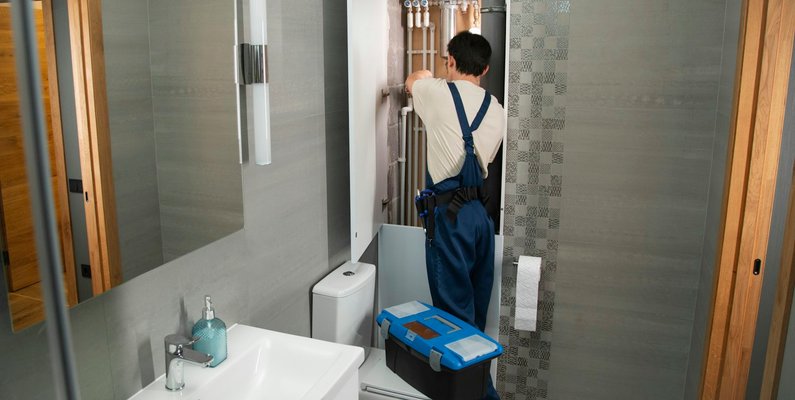
Plumber Web Design: What Actually Turns Visitors Into Booked Jobs

Most plumbing websites are brochures. They list services, show a stock photo of a wrench, and leave the visitor to work out what happens next. Then the owner wonders why the site has never produced a single call.
The fix isn't a redesign for the sake of it. It's understanding what somebody with water coming through their ceiling actually does when they land on your website, and building for that.
The visitor is not browsing
Someone searching for a plumber is in one of two states: something is broken right now, or they're planning work and comparing two or three companies. Neither of them is reading your About page.
The emergency visitor wants one thing — a way to reach you in the next ten seconds. The planning visitor wants evidence you've done their exact job before, and some idea of what it costs.
Almost every decision in plumber web design comes back to serving those two people. If a section on your site doesn't help one of them, it's decoration.
What a plumbing website actually needs
A phone number that's tappable and visible without scrolling. Not in the footer. Not as an image. A real tel: link in the header, on every page, on mobile. This is the single most common thing I fix on plumbing sites and it costs nothing.
Your service area, in words. "Serving Manchester, Salford, Stockport and surrounding areas" beats a map embed, because search engines can read it and so can a customer deciding whether you'll travel to them.
A short form. Name, phone, postcode, and what's wrong. Four fields. Every extra field costs you submissions, and nobody standing in a flooded kitchen is filling in a fifteen-field questionnaire.
Proof. Photos of your own jobs, your Gas Safe or licence number, and reviews with real names. Stock photography actively works against you here — customers can spot it, and it signals that you had nothing of your own to show.
Speed. Plumbing searches happen on phones, often on mobile data, often in a hurry. A site that takes six seconds to load has already lost a share of those people before they see anything. Sub-two-second load times aren't a luxury on a plumbing site, they're the difference between a call and a bounce.
Service pages beat one long list
The most common structural mistake is a single "Services" page listing fourteen things.
Break it up. A page for boiler installation, a page for emergency callouts, a page for bathroom fitting. Each one gets its own title, its own detail, its own photos of that specific work.
This matters for two reasons. Search engines have something specific to rank for each job type instead of one page trying to be about everything. And a customer looking for a boiler swap lands on a page about boiler swaps, not a directory they have to navigate.
The same logic applies to location. If you cover five towns, a page per town — with genuinely different content on each, describing real work you've done there — will out-perform one page that lists all five in a sentence.
What plumber web design services usually get wrong
Three things, over and over:
Building on a locked-down theme. You end up unable to change your own phone number without paying someone. Every site I build is done in Elementor so the owner can edit text and swap photos without calling me for the small stuff.
Designing for the owner, not the customer. The owner wants the logo big and the van photo on the homepage. The customer wants to know if you cover their postcode and whether you can come today.
Treating launch as the finish line. A website that never gets a new photo, a new review, or a new service page will drift down the rankings while competitors who keep adding things drift up.
What it should cost
For a plumbing business, a proper site is a three to eight page build: home, services broken out by job type, service area, about, contact. That's a Starter or Growth package — $530 to $760, live in one to three weeks.
You do not need a $5,000 custom build to book more jobs. You need a fast site that says what you do, where you do it, and how to reach you, with proof attached.
What you should be wary of is the £50/month "free website" deal from a directory company. You don't own it, you can't move it, and when you stop paying it disappears — along with any ranking it built up.
Where to start
If you already have a site, run it through Google PageSpeed Insights and open it on your own phone. Time how long it takes before you can tap the phone number. That single number tells you most of what you need to know.
If you're starting from scratch, get the structure right before you think about design: one page per job type, a real service area page, proof on every page, and a phone number that never leaves the screen.
Want a straight answer on what your plumbing site needs? Tell me what you do and where you work and I'll come back with a page-by-page outline and a fixed price. If it doesn't need rebuilding, I'll tell you that instead.

